
Facebook Twitter

Church of St. Mary at Clinton Heights

Menu
  • Home
  • Sacraments
    • Baptism
    • Reconciliation
    • Confirmation
    • Marriage
    • Last Rites
  • Ministries
    • Ministry Schedules
    • Extraordinary Minsters for Holy Communion
    • Altar Server
    • Pastoral Council
    • Stewardship
    • Choirs & Instrumentalists
  • Multimedia
    • Bulletin
    • Photo Gallery
    • Videos
    • Newsletter
Church of St. Marys logo. Text reads: Church of St. Mary at Clinton Heights
Menu
  • Calendar
    • Mass Times
    • Mass Readings
    • Children’s Mass
    • Events
  • Get Involved
    • OCIA
    • Faith Formation
      • Elementary K – 5th grade
    • Family Formation
    • Vacation Bible Camp
    • Middle School Mission
  • Giving
    • E-Giving
    • Financial Reports
  • Contact
Church of St. Marys logo
Menu
  • Home
  • Calendar
    • Mass Times
    • Mass Readings
    • Children’s Mass
    • Events
  • Get Involved
    • OCIA
    • Faith Formation
      • Elementary K – 5th grade
    • Family Formation
    • Vacation Bible Camp
    • Middle School Mission
  • Multimedia
    • Bulletin
    • Photo Gallery
    • Videos
    • Newsletter
  • Sacraments
    • Baptism
    • Reconciliation
    • Confirmation
    • Marriage
    • Last Rites
  • Ministries
    • Ministry Schedules
    • Extraordinary Minister of Holy Communion
    • Altar Server
    • Pastoral Council
    • Stewardship
    • Choirs & Instrumentalists
  • Giving
    • Financial Reports
  • Contact

Thirteen Months with Pope Francis

April 3, 2014 by

[The following were reflections formulated by Fr. David for the weekly Ecumenical Prayer & Lunch series of our area utilizing Daytime Prayer and Scripture of Matthew 5:2-12a]

Each one of us no matter what our religious tradition has heard of these eight sayings of Jesus known as “the Beatitudes”.  Wherever and whenever they’ve been heard, these words of Jesus have proved fascinating, disorienting, deeply transformative, sometimes even confounding and disturbing …but always unforgettable.

On the Mount of Beatitudes, Jesus gives His great programmatic sermon, laying out a new mode of life …a new law so to speak …and one of happiness or “beatitudo“.

How do we relate joy to the Law?  Freedom doesn’t mean do what I want or be self-determining, instead, we have a freedom for excellence by disciplining our desire.

So what’s he saying here?  The rules that will place within our bodies minds spirit the capacity for joy…of beatitudo.  Let’s explore them…there are 4 positive formulations:

  • “Blessed are the merciful, for they will be shown mercy” mercy or tender compassion is God’s most distinctive attribute.  God is love and so we ourselves are invited to become love itself by sharing mercy so that the divine life increases in us.
  • “Blessed are the pure in heart, for they will see God” you’ll be happy when there is no ambiguity in your heart about what is most important.  What is a saint someone whose life is about one thing …they’re ordered toward pleasing God alone …they are pure in their drive and desire …unadulterated, undistracted.
  • “Blessed are they who hunger and thirst for righteousness, for they will be satisfied” we want many things but what do we fundamentally want?  What is the primal desire or ultimate concern?  If it’s anything other than the will of God …if it’s anything other than righteousness, then we will be unfulfilled.
  • “Blessed are the peacemakers, for they will be called ‘children of God'” since God is creator, He is that power through which all creatures are connected to each other …He’s the connecting force, He is the  unifier of all that He has made.  Therefore the one who has fundamentally ordered his life to God becomes necessarily a peacemaker, for he channels the metaphysical energy that links all things and all people.  One of the most recognizable qualities of those we call saints is their ‘reconciling power’ by which they become almost immediately a child of God …and thus are happy!

Keeping these more positive beatitudes in mind, we can now turn to those other four beatitudes that, at first, might strike us as confounding or unsettling.  First, though, we need to acknowledge something that is common within each of our make-up: there is a deep-seated, infinite longing for God and we attempt to fill that longing or that void with something less than God.  St. Thomas Aquinas named these lesser things as “wealth”, “power”, “pleasure” and “honor”.  We know that we need God but we try to fill the void with something less than God or with a combination of these four things.  The problem is: it’s only in emptying ourselves of such desires for wealth, power, pleasure and honor that we can then be filled by God’s presence, by His blessing, “beatitudo“… happiness!

And isn’t this what Jesus is saying in the other 4 beatitudes? We’re hungry for God, but we strive and strive and strive for those things that we think will satisfy us …only to find out that we aren’t satisfied and so we strive for them even more!  And we panic: we’re looking for a finite good when only the infinite will satisfy us.

But these other 4 beatitudes share blessing with us when we let go of such things:

  • “Blessed are the poor in spirit, for theirs is the kingdom of heaven.”  In other words, blessed will you be when you detach yourself from material things that are self-serving, and instead, seek to use such things for the common good.  It’s in the common good where you can then enter into right relationships with others in the kingdom …thus combating Aquinas’ “wealth” principle.
  • Similarly, “Blessed are those who mourn, for they will be comforted.”  This might better be seen in another translation: happy are you or blessed are you if you’re not addicted to good feelings and physical pleasures.  They’re okay in their moderation, but they aren’t God …and if we look for them to take the place of God, they’ll soon topple us.  Just look at drug abuse, pornography and conspicuous consumption …too many are seeking happiness in pleasure and all they find is sorrow, loss and confinement…thus Aquinas’ “pleasure” principle.

Now, we’re not talking about Puritanism, but rather detachment and spiritual freedom …that freedom for excellence and freedom for God!

  • Jesus says, “Blessed are the meek, for they will inherit the earth.”  In other words, how lucky you are if you’re not attached to the finite good of worldly power, but instead, by being detached, you can become a conduit of God’s own divine power.
  • And the last of the negative beatitudes is, “Blessed are those who are persecuted for righteousness’ sake, for theirs is the kingdom of heaven.”  If the call to poverty wards off the addiction to material things; and the summons to mourn counters the addiction of good feelings; and the glorification of meekness blocks the addiction to power, then this last beatitude gets in the way of the addicting attachment to honor.  If we seek righteousness right relationships among al lthen we will be despised by some.  And when we’re despised by some for this reason, then true honor can be ours.  Take, for example, in the 19th century, Charles Lwanga who was the chief of pages in the court of King Mowanga who governed the region of what is now Uganda.  When the king demanded sexual favors from Charles, the young man refused …even to the cost of his life.  Charles and many of his companions were then burned to death at a place where, today, has become the very focal point of African Christianity.  Charles’ radical detachment from worldly honor unleashed the divine life in an amazingly powerful way.  Thus, a true and humble honor is now his….


Why did I choose these eight beatitudes as our Scriptural point of view today?  Well, the topic of my reflections is Pope Francis, and I would propose that we may have a great embodiment of these beatitudes in a new and contemporary figure, that of Pope Francis.  It may be that Pope Francis’ appeal for many of us is his radical detachment from wealth, pleasure, power, and honor…and his embrace of poverty, discomfort, humility, righteousness and peace.

Alreadyin just fourteen short monthsthe world has been captivated by this radical creature, hasn’t it? …haven’t we?  I recall meeting with Bishop Hubbardthe bishop-emeritus of the Albany Catholic Dioceseback in January of this year with a small group of priests and we were relating the joy and surprise we experienced from the numbers of faithful who celebrated Christmas Masses this past December and Bishop Hubbard’s explanation was “the Francis Effect”: that from his person emanates such an invitation to come and see the Church anew, to experience againand with othersthe presence of God in our midst…that so many were coming to the Church where Francis might be seen and felt.

The Francis Effect

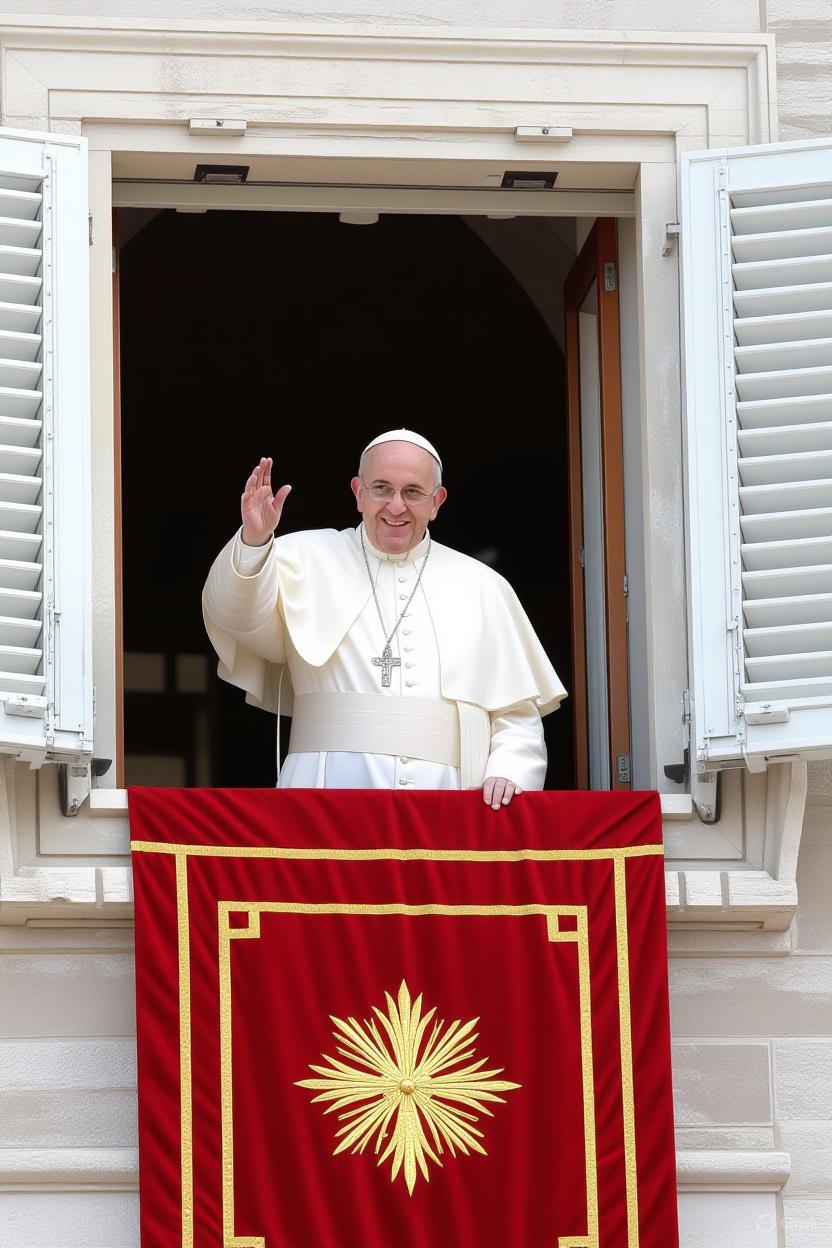
From his earliest days as pope, Francis has re-imagined how he might exercise his role as shepherd.  Without condemnation of prior vicars, Francis has laid aside certain, what I call “small ‘t’ traditions”: the papal automobile is now a Ford focus; the mozzetta is no longer royal ermine, but a simple off-white-colored cloth; his faccia is unadorned and his shoes are worn, dark and dusty.  But don’t be mistaken: these are not mere token gestures or PR stunts; no, these are genuine expressions flowing from a man who has always been this way.  Perhaps from his modest childhood and his humble upbringing, Francis has always been one who is outwardly simple.  And this would be the first word we might use to describe Pope Francis.  Without the trappings, what’s left?  When you peel away the skins of an onion, what remains?  And it is this on which Pope Francis will focus…the heart of the matter.

Simplicity

Recall that during the preparatory meetings of the week leading up to the conclave, then-Cardinal Bergoglio was being housed at a small guest house that is one of many throughout the city used by visiting clergy for the various Vatican offices.  Anyway, immediately after his election, knowing that his insignificant belongings were still occupying the guest room and that the bill was yet unpaid newly elected Pope Francis thought it important to settle his accounts.  And so he did personally.  He hopped a ride to the foyer, gathered his belongings and paid his own bill!  Such simplicity is refreshing isn’t it?

Another expression of simplicity: just last week as the Argentine President was a bit delayed for a lunchtime meeting with Pope Francis, the Holy Father took the fifteen minutes he was waiting and went outside to speak with folks who had gathered outside the gates hoping to get a glimpse of him.  And more than once, he’s never shied away from simply ‘being present to others’.

Just

In the 1990s, I spent six years living and studying in the Vatican.  All throughout that time, we seminarians were encouraged to serve the needs of the poor.  Well, just like any major metropolitan city, it was very hard to see that anything we might do could be of any significant help to someone, let alone aid in serving the needs of the poor as a significant group in any society.  Still we did our best, as little and as insignificant as it might have been.

One of the earliest appointments that Pope Francis made for the city was that of “Papal Almoner”.  No longer was this going to be a mostly-symbolic office, nor would it be led by an aged Cardinal.  Instead, Pope Francis named a young cleric (with stamina and energy and, I might add, a great sense of honesty and personal integrity!) to leapfrog over so many other high-level positions of honor and power…in order to serve the very practical and daily needs of the poor, the outcast, the ugly of the city.  Yes, Francis was going to do his great part in re-establishing justice…for all…especially in service of the poor, the common good…of all!

Collegial & Collaborative

It has been suggested that Pope Benedict XVI knew well the challenges of the Papacy but just didn’t have the strength to repair some of the damages that undoubtedly creep into any ancient institution.  Having served in the Vatican for over 30 years, we can presume that Benedict chose wisely, prudently, faithfully and humbly to step down from the Office of Peter in order for another to take up the great tasks that lie ahead.  With Pope Francis, we now have an outsider, one who is not at all personally familiar with any of the Vatican workings.  We do, however, have a man with so many other gifts that have served every one of his ministries well throughout the past fifty years.

And one of the talents Pope Francis has demonstrated is his desire and ability to gather others around him with whom he can work closely, confidently and collegially.  We’ve all seen power go to some people’s heads, but not with Pope Francis.  Within a few short weeks, he had announced a Council of Eight Cardinals who would help him govern the Universal Church.  And, just in case one might think this is just a smoke-screen, consider that immediately following that announcement, he opened up the long-tainted Vatican Bank for audit and outside scrutiny!  Thank God…because it’s high-time we showed our people how to live by not merely talking the talk, but walking the walk.

Unafraid

There are other things that call to mind a blessed life, a happy life of the beatitudes in Pope Francis.  It is so refreshing and it causes me great, inestimable joy when our Pope can simply walk out a doorway and run toward people who simply want to love him!  In audience after audience, taking selfies with teens and physically embracing a man disfigured since birth with sores and growths and deformities aplenty.  But what does Francis do?  He simply loves him, embraces him, prays for him and holds him.  He’s not afraid of anything: of an assassin’s bullet, of the cringes of the elite, of erroneous criticism such as false-humility or self-serving abasement.  Nope, not Francis: he’s unafraid because he has the knowledge and assurance that this is who God is calling him to be in that very moment: a man of true and abiding love.  It’s simple, and it’s beautiful.

Communal

One of the first criticisms I began to hear of Pope Francis was that he might be one to do away with some of the glorious riches of our tradition.  So, for example, art has always flourished under the patrimony of the Catholic Church.  For centuries, the Church supported artists in their quest to find Beauty.  While this has been a gift, it’s also proven often to be a double-edged sword.  So often we have heard of calls for the Church to divest herself of artto sell everything in the Vatican museums and feed the world’s poor.  While there are significant arguments against such a moveand Francis knows them wellstill, he has shunned living in the very posh and comfortably decorated and highly adorned Apostolic Palace.  It’s true: the palace is more than remarkable…and some see this as a first step in taking the “poverty thing” too far.  But this is not what’s happening with him at all.

Sure, Pope Francis has chosen not to live in the Apostolic Palace, but not because of a statement of value, but rather he chooses to live in Domus Sancta Martathe Vatican’s guest housebecause Francis knows himself extremely well and he admits of his great need for social community.  He doesn’t want to eat alone or in a scripted ceremony; he wants to watch the news with others; he wants to be among people and, most of all, he wants to celebrate Mass each morning with a congregation and a homily.  Yes, Francis is a very sociable creature and as such, he knows well that he can only flourish with others, and not apart from them.  This is a good thing…nothing worth fretting over nor condemning.  And so, I for one, am happy that his days are filled with such simple joys, too, mixed in with all the other important universal responsibilities this gentle man has undertaken.

Seeker

When I was a young boy, my dad tried to teach me the practical workings of a small engine.  I guess he was hoping I’d grow up as a mechanic and save our farm a mint on tractor and car repairs!  Well, I quickly proved him the fool as I dissected three tractors at once and found myself confusing interchangeable parts among them.  It took a seasoned mechanic a few extra days to undo my doing!  Apparently my gifts weren’t in the very practical, but are rather found in the theoretical realm of thought, of ideas and of the soul.

Well, from the beginning of his pontificate, Francis has taken his time to remember he is a Jesuit!  And as any good member of the Society of Jesus, he must seek to discern, to rediscover the value and beauty of a thing, its participation in what is true, right and good.  In other words, he won’t accept something on face value simply because it’s always been accepted or done this way or that; no, he’ll dissect something, check all elements to be sure that everything that is necessary is there and those things that are not, are not.  He’ll then re-assemble the thing and once it is known, he will exercise it well.  So, for example, when certain dicasteries or groups of offices have always and only been staffed with priests or religious, Pope Francis will first consider their task, then their competence, then their gifts…all in order to discern whether or not the group will be able to accomplish well their tasks…without the benefit of the laity, or of women, or of people of other faiths. You see, Francis isn’t the Shepherd of the Church so that he simply maintains a blind or insensitive continuity for continuity’s sake; no, instead, he is unafraid to seek.

Maybe an example will help: one of the most influential and powerful offices in the Vatican which intimately affects every single diocese throughout the entire world is called the Congregation for Bishops.  It is the office that basically proposes new bishops to the Holy Father and matches them to specific areas.  While most of its workings are highly sensitive and confidentialas we can imagine is necessarystill, the processes and criteria it uses to ascertain the suitability of bishops need not be.  And Pope Francis has begun to publicize such details, for the good of the Church and for our own personal good.  As Francis has said time and time again, we need bishops who smell like the sheep, who live with us, understand us, are empathetic toward us, are seeking justice for us, are weighed down with heavy hearts…just like us.  Although he’s spent hours re-defining the criteria for new bishops, Pope Francis is seeking shepherds after the heart of the Lord Jesus Himself.  And that’s it: no politics, no secret deals, no grandstanding or positioning…just, pure and simple, good holy pastors to shepherd the dioceses of the faithful.  And thank the Good Lord…isn’t that what Jesus sought out?  When He chose the Twelve, he picked men who could most closely relate with all peoples…and who would be open to hear Him, His message, and follow Him.

Joyful

We could go on and on with many more reflections…and it would be great fun and of lively interest, but I am aware that lunch is wafting its scent into this Church and the sound of stomachs grumbling is soon to follow, so I’ll end with just one more image…it is that of JOY.

The very first major written work of Pope Francis was recently published with the title, “The Joy of the Gospel”.  This document, while outlining many contemporary issues faced by the modern world and significant threats to goodness and right, still the pontiff is able to find reason for rejoicing: that God is still very much in our midst.  Most clearly, God can be seen when we look very plainly and simply at the poor, the marginalized, the outcast and the unloved.  As much as pundits and economists have scoffed at Pope Francis as unrealistic and purely foolish in his views, still Francis rejoices: in a very real and tangible way, we can witness the presence of God as easily as when we become one with those who are “lesser”, when we can see the other not as ‘other’, but rather as ‘another’ who has been loved into existence by God, redeemed in our need by God, and called into deeper friendship with the God of all humankind.

May this new shepherd remain in our midst as one who calls us out of darkness to live in the blessedness of God’s own life…and may beatitude grow within us this Lent.


Filed Under: Fr. David's Blog

Ordination is for “Loving Service”

March 26, 2014 by

[As a parish priest, and from my reading of today’s general audience with Pope Francis, I pray that I–along with all my brother deacons, priests and bishops–are more and more conformed to Jesus Christ, the High Priest as “a loving servant of His people”.  Please keep each of us in your daily prayers.  Finally, thanks to so many of my parishioners who encourage me, challenge me, and offer loving prayers for me: I have been greatly blessed here at the Church of St. Mary!]

Vatican City ( AsiaNews) – Bishops and priests are placed “at the head”, or in other words “at the service” of the community entrusted to them , that is their “family” and not their “property”. A bishop who is not in the service of the community does not do good, a priest who is not in the service of his community does no good, they are wrong”. “So let us help them continue to pray” and “pray for those who are in difficulty”.

The sacrament of Holy Orders was the focus of Pope Francis audience with 60 thousand people present in St Peter’s Square , where he was greeted by a fanfare from the trumpets of Italy’s famed military Bersaglieri troopers.

On a drizzly day – “I see that you are brave with this rain that wants to drive you away” – the Pope said that “there are sacraments which correspond to two specific vocations: Holy Orders and Matrimony. They constitute two major pathways through which the Christian can make his or her life a gift of love, following the example and in the name of Christ, and thus cooperate in the building of the Church”.

“Holy Orders, in its three grades of bishop, priest and deacon, is the sacrament of pastoral ministry. Jesus entrusted his Apostles with the care of his flock and in every age the ordained make present in the Christian community the one Shepherd who is Christ. Care for the flock of Jesus not with the power of human strength, one’s own power, but that of the Spirit, and according to his heart – the heart of Jesus – that is a heart of love. The bishop, priest and deacon must feed the Lord’s flock with love. If they do not do this with love, they are no use. It is in this sense, that the ministers, who are chosen and consecrated to this service, prolong the presence of Jesus in time.  They do so with the power of the Holy Spirit in the name of God and with love”.

“Those who are ordained are placed at the head of the community. Yes, they are “at the head” but for Jesus this means authority in service, as he himself has shown and taught his disciples”. “A bishop who is not in the service of the community does not good. A priest, who is not at the service of his community, does no good. They are wrong”.

“Another characteristic of this sacramental union with Christ is passionate love for the Church. Think of that passage from the Letter to the Ephesians, where St Paul says that Christ “loved the Church and gave himself up for Her to make Her holy, purifying Her by washing of water through the Word and to present the church to himself in splendor, without blemish or wrinkle or any such thing. Pursuant to Holy Orders, the minister devotes himself entirely to his community and loves it with all his heart, it is his family. The bishop, the priest, love the church in their community and their love for it is strong. How? Just as Christ loves the Church. St. Paul himself says of marriage: the groom loves his wife as Christ loves the Church. It is a great mystery of love, this ministry and that of marriage, the two sacraments through which people usually go, as a sacrament, to the Lord”.

“The apostle Paul advises his disciple Timothy not to neglect, indeed, to rekindle the gift that is in him: the gift that was given to him by the laying on of hands. When one fails to nourish the ministry, the ministry of bishop, the priestly ministry with prayer, listening to the Word of God, and with the daily celebration of the Eucharist and also with an attendance of the Sacrament of Penance, one will inevitably lose sight of the true meaning of its service and the joy that comes from a deep communion with Jesus. A bishop who does not pray, the bishop who does not feel and hear the Word of God, who does not celebrate Mass every day, who does not go to confession regularly, and the same priest who does not do these things, in the long run lose their union with Jesus and become a mediocrity that is not good for the Church. This is why we need to help the bishops, the priests to pray, to listen to the Word of God which is their daily bread, to celebrate the Eucharist every day and to go to confession regularly. And this is so important because it goes towards the sanctification of bishops and priests”.

And finally, the Pope asked, “How does one become a priest? Where are the entrance tickets sold? It is an initiative that the Lord takes. The Lord calls: calling everyone who wants to become a priest, and perhaps there are some young people here who have felt that call in their hearts. The desire to become priests, the desire to serve others in the things that come from God.  The desire to spend one’s entire life in service to catechize, baptize, forgive, celebrate the Eucharist to the sick … but, all of one’s life! If any of you have heard this in your heart, it is Jesus who put him there! Care for this invitation and pray that this will grow and bear fruit for the entire Church”.

Filed Under: Fr. David's Blog

On ‘Being Christian’

March 26, 2014 by

[This article was published by AsiaNews last May following a general audience presentation by Pope Francis.  As I re-read it today, my mind grapples, too, with the issues raised before the Supreme Court of the United States of America and the Affordable Care Act and its requirements.  How we reconcile our faith in the public square will be an ongoing challenge.]

F_-_piazza_pioggiVatican City (AsiaNews) – You cannot be a “part-time” Christian, “at certain moments, circumstances, choices” ” faith must guide our lives, because the “truth that the Holy Spirit gives us always and totally involves our daily lives”. In an era marked by relativism, that “the truth lies in consensus,” Pope Francis reminds Christians that “Jesus is the Truth,” and the Holy Spirit He who “guides us on the path of knowledge of the truth”, to the “things of God. ”

80 thousand people were present for the Pope’s audience, among which, as has become customary, he made a lengthy tour of greeting, with people cheering, children to kiss and some gifts. O singular interest today, a cage with two white doves, which Francis released to the applause and jubilation of the crowd.

Francis dedicated his reflection “to the action that the Holy Spirit accomplishes in guiding the Church and each one of us to the Truth.” But “we live in an age rather skeptical of truth. Benedict XVI has spoken many times of relativism, that is, the tendency to believe that nothing is definitive, and think that the truth is given by consent or by what we want. The question arises: does “the” truth really exist? What is “the” truth? Can we know it? Can we find it? Here I am reminded of the question of the Roman procurator Pontius Pilate when Jesus reveals the profound meaning of his mission: “What is truth?” (Jn 18,37.38). Pilate does not understand that “the” Truth is in front of him, he cannot see in Jesus the face of the truth, which is the face of God yet, Jesus is just that: the Truth”.

“You cannot grab the truth as if it were an object, you encounter it. It is not a possession, is an encounter with a Person. But who helps us recognize that Jesus is “the” Word of truth, the only begotten Son of God the Father? St. Paul teaches that “no one can say, “Jesus is Lord,” except by the Holy Spirit” (1 Cor 12:3). It is the Holy Spirit, the gift of the Risen Christ, which helps us recognize the Truth. Jesus calls him the “Paraclete”, meaning “the one who comes to our aid,” who is by our side to support us in this journey of knowledge, and at the Last Supper, Jesus assures his disciples that the Holy Spirit will teach them all things , reminding them of his words (cf. Jn 14:26)”.

“What is then the action of the Holy Spirit in our lives and in the life of the Church to guide us to the truth? First of all, remind and imprint on the hearts of believers the words that Jesus said, and precisely through these words, God’s law – as the prophets of the Old Testament had announced – is inscribed in our hearts and becomes within us a principle of evaluation in our choices and of guidance in our daily actions, it becomes a principle of life”.

“The Holy Spirit, then, as Jesus promises, guides us “into all truth” (Jn 16:13) he leads us not only to an encounter with Jesus, the fullness of Truth, but guides us “into” the Truth, that is, he helps us enter into a deeper communion with Jesus himself, gifting us knowledge of the things of God. We cannot achieve this on our own strengths. If God does not enlighten us interiorly, our being Christians will be superficial”.

“Let’s ask ourselves: are we open to the Holy Spirit, do I pray to him to enlighten me, to make me more sensitive to the things of God? And this is a prayer we need to pray every day, every day: Holy Spirit may my heart be open to the Word of God, may my heart be open to good, may my heart be open to the beauty of God, every day. But I would like to ask a question to all of you: How many of you pray every day to the Holy Spirit? Eh, a few of you I bet, eh! Well, a few, few, a few, but we realize this wish of Jesus, pray every day for the Holy Spirit to open our hearts to Jesus!”.

“Do not be a ‘part-time” Christian, at certain moments, in certain circumstances, in certain choices, be Christian at all times! The truth of Christ, which the Holy Spirit teaches us and gives us, always and forever, involves our daily lives. Let us invoke him more often, to guide us on the path of Christ’s disciples Let us invoke the Holy Spirit everyday! Thus the Spirit will bring us closer to Jesus Christ. Thank you”.

Filed Under: Fr. David's Blog

Those Darned Temptations

March 10, 2014 by

Over the last several weeks, we’ve been hearing from the Sermon on the Mount, you remember: when Jesus preaches the beatitudes, like: blessed are the merciful; blessed are the pure of heart, blessed are those who seek righteousness, and those who are peacemakers.  We’ve been hearing where blessedness can come from when we accept God’s grace.

And in today’s first reading, we hear the exact opposite: we hear of the origin of sinfrom the very generosity of God in giving life and blessing to Adam and Eve, what do they do in response?  In the face of temptation, they sinned.  Yes, the devil (or serpent) was cunning, inflating God’s command, “Did God really tell you not to eat from ANY of the tress…?”  And from that inflation, the sin is compounded when Eve responds, “You shall not eat it OR EVEN TOUCH IT, LEST YOU DIE.'”  Funny, God said no such thing.  So, in the face of temptation, Eve…and Adam, fall.  And bring sin upon all of us by inheritance.

So, what might we take from this during the Lenten Season?  I would suggest three things.

First, temptation is not a sin.  Christ himselfwho is the Son of God and has no sin whatsoeversuffers temptations (as we heard in today’s gospel).  He was invited to disobey God’s will, not once, but three separate and distinct times.  As His followers, then, we should expect nothing less.  We too will experience temptation, but know that when we battle temptations, when we fight them, we can actually grow in our love for God, in our inner strength and perseverance.  So, tonight, when I’m tempted to eat black licorice and have my martini, two things I’ve offered up for Lentthat’s not a sin…unless I give in to those temptations!

Second, the devil is real.  St. Matthew leaves no room for doubt on this point!  The reason the Spirit led Christ into the desert in the first place, he tells us, was “to be tempted by the devil”.  Not sure how the devil is present, we are still very sure that the devil is present, stirring up opposition, multiplying difficulties, and putting up plenty of roadblocks.  And if Christ was tempted by the devil, there should be no surprise to us when we’re tempted by that same devil.

temptations of christThirdand most importantlythe devil shows his 3 favorite tricks in our gospel…the same tricks that he continues to play on us according to St. Thomas Aquinas.  In order to divert us from God’s path, the devil will appeal to the exact opposites of the beatitudes (those graces we’ve been hearing of in these last weeks):

  • The devil says, “Turn these stones into bread”.  Today, he might be saying to us, “Turn these stones into jelly donuts”, or “you should have all that brings you pleasure”.  But St. Thomas says that the beatitudes congratulate us when we’re not addicted to pleasure, but we’re blessed when pleasing God is our only goal.
  • The devil says, “Throw yourself down from the temple…angels will catch you.”  To us today, he might say, “do a swan dive from a high point…that will impress onlookers”, thus tugging at our inner desire to be recognized.  Yet St. Thomas says that the beatitudes bless us when we seek to give honor to God alone.
  • The devil says, “bow down and worship me and I’ll give you everything.”  To us today, he might say, “Just do it…it’ll make you rich and powerful.”  But St. Thomas Aquinas instructs us: “when we are meek, we inherit the infinite; when we are detached, it is then that we can possess God’s own being.”

My brothers and sisters, we will be tempted, but what is important for us as Disciples of Christ, is how we prepare ourselves for such temptations and then, how we respond to those temptations.  In this Lenten Season, we are invited to enter into the desert with Christ, to rely solely on the Lord God’s power and strength and goodness and love.  God will help us as we turn to Him.  Yes, our desires for wealth, power, pleasure and honor run deep, but to be able to resist them, like Christ did, all we need do is “set our hearts on His kingdom first” (Mt 6:33), and then everything else will fall into place.

May God’s blessings be with us in all our temptations.

Filed Under: Fr. David's Blog

Idolatries that Impede Vocations

March 3, 2014 by

This was released earlier today by the Zenit News Agency:

Pope Francis Calls for Prayer for Vocations

Reflects on Idolatries that Impede Young People from Answering Call to Follow Christ

VATICAN CITY, March 03, 2014 (Zenit.org) – During morning Mass at Casa Santa Marta, Pope Francis called on the faithful to pray for vocations free from the idolatries of this world. The Holy Father based his homily on today’s Gospel from St. Mark, which recalled the meeting between Jesus and the rich young man.

“Good teacher, what must I do to inherit eternal life?” the young man asks Christ. The Pope noted that although the young man was good man who observed the commandments, he wanted more. “The Holy Spirit urged him,” the Pope said.

The Gospel recounts that Jesus told him to sell his goods, give the money to the poor and follow him. Upon hearing this, the rich young man went away sad.

“His heart was restless, because of the Holy Spirit that urged him to come closer to Jesus and follow him, it was a full heart, and he did not have the courage to empty it,” the Pope explained.

“And he made the choice: money. A heart full of money…But he wasn’t a thief, a criminal: no, no, no! He was a good man: he never robbed, never! He never swindled: it was honest money. But his heart was imprisoned there, he was tied to money and he did not have the freedom to choose. Money made the choice for him.”

The Holy Father went on to compare the rich young man’s dilemma with the struggle today’s youth go through in answering God’s call. Many who do feel the call resist because their hearts “are full of other things” and do not have the courage to empty it.

“We should pray so that the heart of these young people can be emptied, emptied from other interests, from other loves, so that the heart can become free,” he said. “And this is the prayer for vocations: ‘Lord, send us, send us nuns, send us priests, defend them from idolatry, from the idolatry of vanity, from the idolatry of pride, from the idolatry of power, from the idolatry of money.’ And our prayer is to prepare these hearts to be able to follow Jesus closely.”

Concluding his homily, Pope Francis urged the faithful to pray for young people who have a vocation today so that “they may be free and not be slaves” to their idolatries.

“We should help them so that they may grow, so that the Lord can enter in those hearts and give this indescribable and glorious joy that each person who follow Jesus closely has,” he said.

Filed Under: Fr. David's Blog

  • « Previous Page
  • 1
  • …
  • 18
  • 19
  • 20
  • 21
  • 22
  • …
  • 41
  • Next Page »
Church of St. Marys logo

Contact Us!

Church of St. Mary at Clinton Heights
163 Columbia Turnpike
Rensselaer, NY 12144-3521
(518) 449-2232

Search

Quick Links

  • Mass Times
  • Bulletin
  • Photos
  • Videos
  • Upcoming Events
  • Ministry Schedules
  • Gala & Auction
Presider's Portal Login

Recent Updates

  • The Third Sunday of Advent
  • Solemnity of the Immaculate Conception of the Blessed Virgin Mary & Mass of Installation of Pastor
  • The Second Sunday of Advent
  • Feast of St. Nicholas
  • December Advent Gatherings & Celebrating You!

Connect With Us!

Facebook logo Twitter logo

Get Our App!

Download our app on the Google Play Store
Download our app on the App Store

Serving Since

Copyright ProspectGenius and Church of St. Mary at Clinton Heights 2026

Calendar